“Oh wow, this flyer looks nice. Oh, this one, too. Is there another QR code? Sure, I’ll scan it. It’s another opportunity.” This was my habit of collecting all the flyers distributed from the booths in front of my school’s library. I remember how lost I felt during my first year. I didn’t know where to start, and wanted to apply to each opportunity on campus. When I immigrated to the United States as a first-generation, low-income student, I knew two things: I wanted to pursue medicine to help underserved communities, and I wanted to assist others in pursuing medicine as well.
During my early premed years at UC San Diego, I saw how many talented, driven students were struggling, not because they lacked ability, but because they lacked support. Many had never shadowed a physician, didn’t know how to write a personal statement, and had yet to meet a healthcare professional who looked like them. Many students don’t even know what’s required to make it to medical school and that some need to take a gap year. True, there were so many premedical organizations on campus, but I realized that what we needed was a community of students advocating for free resources!
So, I created that community: the Undergraduate MD/PhD Society (UMPS), a 501(c)(3) nonprofit that now supports over 1,200 underserved premed students across UC San Diego, UC Los Angeles, and UC Irvine. Our mission is to empower students, especially those from underrepresented backgrounds, to pursue MD, PhD, and MD/PhD programs through student-led trainings, mentorships, and access to real community/ clinical service opportunities and research experiences.
As a new organization on campus, we faced major challenges, such as navigating resources. Initially, because we were virtually unknown to the community, we weren’t given much attention by faculty or students. We also lacked a sufficient financial capacity to expand the club so, I developed a structured plan and drew money from my own pocket in order to grow the organization. I sent hundreds of cold emails introducing the club to professors and delivered elevator pitches after large lectures. My fellow UMPS board members and I were able to increasingly recruit students and spark faculty interest in our cause. UMPS then began inviting faculty, admissions directors, physicians, and professors to speak with students about what it realistically takes to get accepted to medical school. These events helped demystify the process and gave students access to expert guidance.
Next, we focused on further preparing students through application workshops, essay-writing sessions, and candid conversations about crafting a personal statement, and how to navigate the process. We even hosted a medical school fair with 20+ medical schools, including international medical schools, to share program information and connect with students. The event broke the record for having over 400 student registrants in the history of the fair, a powerful reflection of the unmet demand for accessible, high-impact guidance among premedical students.
As UMPS continued to grow, we recognized something critical was still missing: access to clinical experiences. Many of our members, particularly those from low-income or first-generation backgrounds, struggled to access these experiences, which are highly recommended by medical schools. With intense competition for clinical opportunities and some roles, like medical assisting, requiring costly certifications or further education, many premed students face barriers to gaining hands-on clinical experience. I funded my own national certified medical assistant (NCMA) training by working four jobs while in high school. I realized I could use medical assisting skills to help others bridge that same gap, for free.
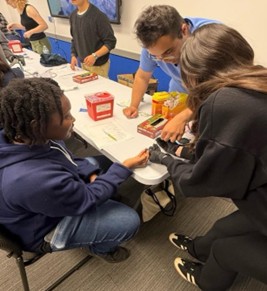
I launched, “Happy Weekends,” the clinical outreach branch of UMPS, which also hosted health screening initiatives in the San Diego community, partnering with local non-profit organizations. Through Happy Weekends and help from partner health care professionals, I help train students in basic clinical procedures like checking blood pressure, measuring blood glucose, and conducting vision tests. Watching students nervously poke each other while training to perform glucose checks was inspiring. Students holding the needles were flinching, unsure of their technique, but as their confidence grew, so did their sense of purpose. These same students soon began performing real health screenings for underserved communities, under supervision of health care professionals, resulting in delivery of care and compassion to those who needed it most.
Witnessing this transformation made me wonder: could early clinical exposure help students, especially those from underserved backgrounds, feel more confident about pursuing medicine? That question led to a research study we conducted through UMPS, “From Access to Aspirations: Determining How Clinical Preparedness Influences Confidence in Underrepresented Pre-Medical Students,” which is currently pre-printed by Social Science Research Network (SSRN).
Our findings revealed that students from underserved backgrounds, particularly first-generation and low-income students, reported significantly lower confidence levels than their more privileged peers before participating in the clinical simulations. In addition, the qualitative data told a richer story: students repeatedly emphasized how hands-on exposure, peer mentorship, and a welcoming community helped them feel less alone and more capable to apply to medical school. In a premed landscape that often feels inaccessible, that shift in mindset can be transformational.
Thinking back to my first days, walking past the student center, grabbing every flyer I could find, worried I’d miss out on any opportunity, I know I was trying to find a way of reassuring myself that I’d figure it out somehow. Now, I realize I wasn’t alone. It’s normal for students to search for direction, support, and a place to belong. UMPS became that community. Although I don’t know where each student will wind up, I know many came away believing they could make it on their journey, and that has made all the work to found and maintain UMPS worth it.
Subscribe
Comments
No comments yet!
Be the first to comment on this story.
Your email address will not be published. All fields are required. All comments are reviewed before appearing on this page.